


How to avoid feature creep in digital projects
“How to avoid feature creep in digital projects” is a common concern when a product begins to grow uncontrollably and the initial scope becomes diluted over time. In software projects, this phenomenon usually appears gradually and almost imperceptibly, until it impacts deadlines, budget, and quality.
What is feature creep and why does it occur?
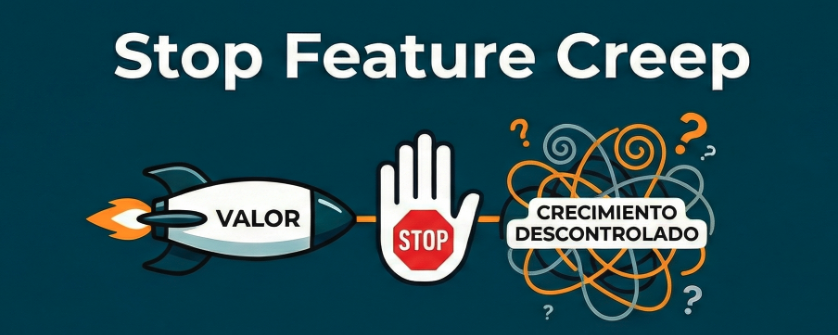
Feature creep occurs when new features are continuously added without a clear assessment of their actual need or impact on the project. It is not usually the result of a single bad decision, but rather an accumulation of small concessions.
The most common causes include:
- Vague or ambiguous initial requirements.
- Lack of a clear product owner.
- Pressure from different stakeholders with different objectives.
- Confusion between desirable improvements and essential requirements.
- Absence of a formal prioritization process.
In Agile development environments, the risk does not disappear on its own. Poorly managed flexibility can become a constant channel for uncontrolled change.
Early signs that a project is drifting
Detecting feature creep early on is key to avoiding costly corrections later on. Some common signs are easy to recognize when viewed with perspective.
The backlog grows sprint after sprint without clear objectives being completed. Estimates are consistently missed. The team spends more time on adjustments and exceptions than on advancing the core of the product. The final product becomes difficult to explain in a simple sentence.
When these signs appear, the problem is no longer technical, but one of scope management.
Define the scope well from the start
A solid project begins with a clear definition of what is to be built and, equally important, what is left out. The scope is not a static document, but a constant reference.
A good practice is to work with:
- A clear and measurable business objective.
- A small set of priority use cases.
- Well-defined acceptance criteria.
- An explicit agreement on how changes will be managed.
At this point, the role of the Product Owner or product manager is crucial. Without someone to make final decisions, the scope tends to become diluted.
Prioritize judiciously, not impulsively
Prioritizing is not about choosing what sounds best, but what provides the most value in relation to its cost and risk. Frameworks such as MoSCoW, WSJF, or simple value-effort matrices help you make rational decisions.
A practical rule is to link each new feature to a specific metric. If you can’t explain what improvement it makes or what problem it solves, it’s probably not a priority at that moment.
In business projects, this discipline protects both the technical team and the organization itself.
Use Agile with clear structure and boundaries
Agile does not mean accepting any change at any time. It involves inspection and adaptation within a defined framework. Sprints, ceremonies, and backlogs exist to introduce order, not to eliminate it.
Some practices that help contain feature creep are:
- Continuously refined and prioritized backlog.
- Clear and non-negotiable sprint goals during the sprint.
- Impact review before accepting new stories.
- Visible roadmap shared with all stakeholders.
Transparency reduces informal pressure to introduce last-minute changes.
Measure the real impact of each change.
Every new feature has a hidden cost in development, testing, maintenance, and future complexity. Evaluating that impact before approving changes the conversation.
Simple questions help filter proposals:
- What specific problem does it solve?
- Who does it benefit and in what context?
- What is delayed or eliminated to make room for it?
- How will its success be measured once in production?
This approach connects technical decision-making with business objectives.
The role of the technology partner
Having an experienced development partner significantly reduces the risk of feature creep. A team accustomed to working with executives and business managers brings judgment, not just execution capabilities.
At Koukio, scope management is part of the process from the early stages of the project. Working with Agile methodologies, clearly defining requirements, and constant communication allow us to stay focused on what really adds value, without losing flexibility or control.
A well-managed digital project is not the one with the most features, but the one that best solves the problem for which it was created.
